
From Taipei to Shanghai: How ICCs Keep Rotary Connected for Peace
The Rotary International Convention in Taipei could easily have been the end of the journey. For a group of us, though, it was only the first stop.
A few days later, on 19 June, we were in Shanghai for a special ICC Conference and Fellowship hosted by Rotary China and ICC China at the Millennium Hongqiao Hotel. It turned out to be a fitting follow-on to Taipei: less about the scale and spectacle of a Convention, and more about something very close to the heart of ICC —people from different countries sitting down together, sharing ideas and looking for ways to work together.
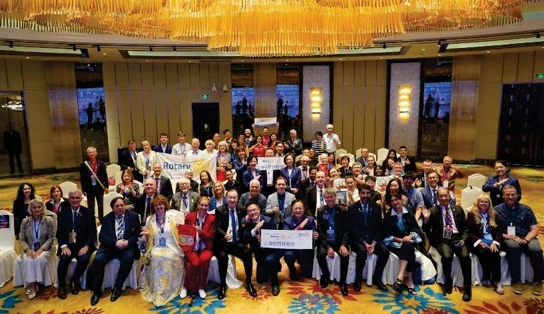
That matters, especially now.
At a time when international relationships are under strain, ICCs have a very practical role to play in keeping Rotarians connected across borders. They do not replace Rotary’s formal peace programmes, but they help create the relationships that make cooperation possible in the first place.
And Shanghai was a good example of that.
Our hosts, Richard Zi, National Chair of ICC China, and Ian Chen, Special Representative for Rotary International Special Area 52, could not have been warmer or more attentive. They introduced us to Rotary’s history and development in China and made clear how keen Chinese Rotarians are to build stronger ICC links with the wider Rotary world.
Their hospitality was every bit as important as their presentations. From arrival to dinner, they and their colleagues made everyone feel genuinely welcome.
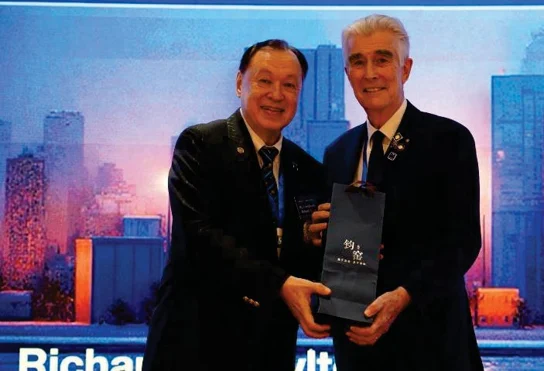
A special word of thanks must also go to Tiziana Richiardi, Chair of the China Section of the ICC between China, Italy, San Marino and Malta, whose quiet but tireless work liaising with visitors and hosts helped the whole programme run so smoothly.
Different countries, the same idea
What made the afternoon interesting was not just the variety of speakers, but how often their experiences came back to the same basic ICC message: relationships have to be active if they are going to matter.
Claudine Schooley spoke about the continuing development of ICCs in the United States, including new links with China and the Philippines around the Taipei Convention. Her message was refreshingly practical: the signing ceremony is only the beginning. What really counts is what happens afterwards —regular contact, projects, exchanges, visits and the friendships that keep an ICC alive.
PDG Andrzej Ludek gave us the longer view. Poland’s ICC experience stretches back more than three decades, beginning with Poland-France in 1991 and Poland-Germany in 1994. His examples showed what can grow from sustained relationships: conferences, training, youth activities, humanitarian cooperation and, importantly, friendships that survive political changes and the passage of time.
DG Svetlana Zhukova brought a very different perspective from Russia. District 2223 covers an enormous territory, yet its Rotarians are running practical projects for children with disabilities, supporting flood-affected communities, developing youth programmesand using online training to overcome huge distances between clubs.
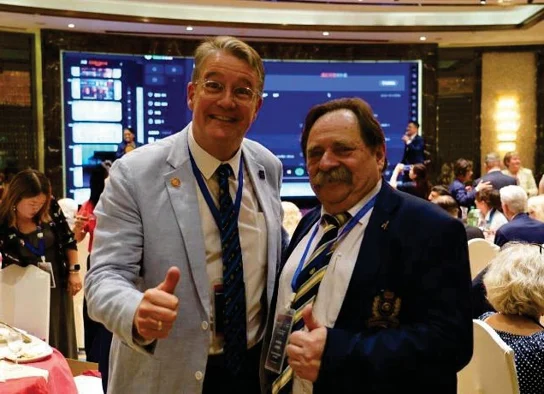
Her final appeal could almost have been written for the Shanghai meeting itself: make friends and unite with Rotarians from all countries for the sake of good.
That sentence carried particular weight. Whatever the wider political climate, Rotarians from Russia were there in Shanghai, meeting colleagues from China, the United States, Poland, Italy and elsewhere. That is exactly the kind of human connection ICCs are designed to preserve.
DG Guido Giuseppe Abbate brought us back to Italy, introducing the scale and variety of Rotary there and the work of District 2072. He highlighted youth engagement and a mobile medical unit providing free health screening, but his closing invitation was perhaps the most ICC like part of his presentation: come to Italy, build club partnerships and develop international projects together.
My own contribution, “ICCs and Peace in Rotary”,tried to draw those different strands together. The central point was simple:
peace building is not only about formal peace programmes. It is also about the conditions that allow people to trust, understand and work with one another.
That is where ICCs can make a distinctive contribution. Youth exchanges, professional contacts, humanitarian projects, cultural activities and long-term friendships all help create the human infrastructure for cooperation. In that sense, ICCs support Rotary’s wider peace ambitions by keeping relationships open, practical and personal.
Why Shanghai mattered
The significance of the meeting was not that everyone came from countries that agreed with one another. Quite the opposite.
The value lay in the fact that Rotarians from countries including China, Russia, the United States, Poland and Italy were sitting together, listening to each other and looking for ways to cooperate.
People were still talking.
They were still exchanging ideas.
They were still looking for projects they could undertake together.
That may sound simple, but in a difficult international climate it is anything but trivial.
And then came the Fellowship
Of course, no ICC event would be complete if everyone simply listened to presentations and went home.
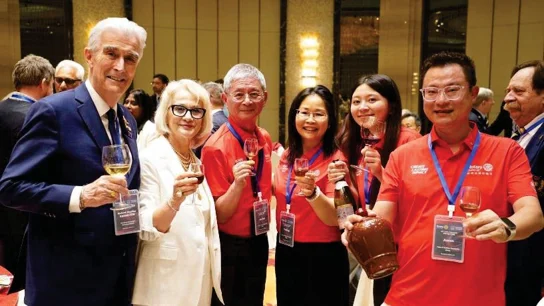
The conference gave way to fellowship and an ICC China gala dinner, and in many ways that was where the ICC spirit became most visible. Pennants and gifts changed hands, old friends met again, new friendships began and conversations continued long after the formal programme had ended.
The photographs probably tell this part of the story better than words.
Taipei showed that the ICC network is continuing to grow.
Shanghai showed why that growth matters: because keeping people connected across borders, especially when the international climate is difficult, is itself part of Rotary’s contribution to peace.


 English
  French
  Spanish
  Italian