
Arch Tutu Greenhouse Soweto – Aquaponics Inauguration
Tutu’s House Becomes the World’s Headquarters Against Hunger.
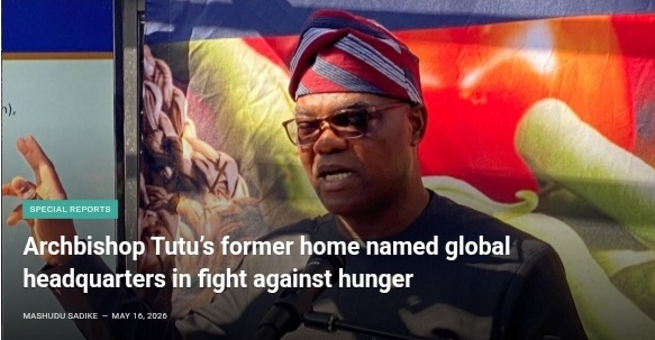
In Soweto, the Global Headquarters of the Desmond Tutu Programme to End Global Hunger is formally established. Rotary District 9400, Fresh Ministries and the incoming President of Rotary International converge on Vilakazi Street.
There is a street in Soweto that the world has come to recognize not for its houses, but for what those houses contain. Vilakazi Street, in the Orlando West neighborhoods, is the only road on earth to have sheltered two Nobel Peace Prize laureates: Nelson Mandela, father of the rainbow nation, and Desmond Mpilo Tutu, archbishop, civic prophet and moral conscience of post-apartheid South Africa.

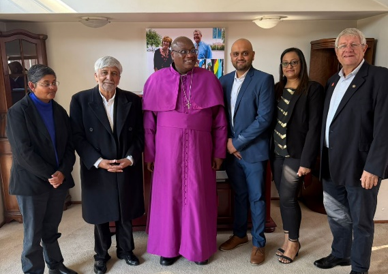
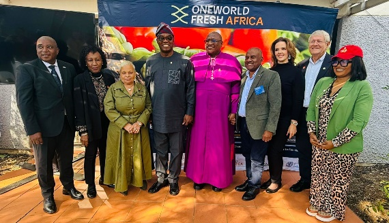
It is against this backdrop of extraordinary historical density that, on 15 May 2026, an act of both symbolic and operational significance took place: Bishop Tutu House was officially declared the Global Headquarters of the Desmond Tutu Programme to End Global Hunger. The ceremony brought together religious leaders, Johannesburg civic authorities and the highest-level representation of Rotary International. This was not a protocol event. The content was concrete: a Global Grant of 94,000 US dollars — approximately 1.5 million rand — allocated to the installation of a state-of-the-art aquaponics greenhouse unit within the Vilakazi Street property, bequeathed by the Tutu family to the Anglican Diocese of Johannesburg and long regarded as one of the nation’s moral landmarks. An African President for an Africa Free from Hunger.
Presiding over the ceremony was Olayinka Hakeem Babalola, a Nigerian national and member of the Rotary Club of Trans Amadi, Rivers State, currently serving as President-Elect of Rotary International for the 2026–27 term, which formally begins on 1 July 2026.
Babalola will be only the second African in history to lead Rotary International — the first was fellow Nigerian Jonathan B. Majiyagbe, who served in 2003–04 — and his physical presence in Soweto, mere weeks before his installation, already signals a clear geographic and thematic priority.

His presidential theme — Create Lasting Impact — finds in Vilakazi Street a concrete and immediate embodiment. An engineer by training and former senior executive at Shell PLC across four continents, Babalola has built within Rotary a record of rare institutional solidity: District Governor (2011–12), Vice President of Rotary International (2019–20), member of the RI Board of Directors (2018–20), trustee of ShelterBox UK, director of the Safe Blood Africa project and Arch Klumph Society member. He is also the architect of the Rotary Peace Center at Makerere University in Kampala, Uganda. His approach to hunger is systemic — not charitable, but transformative. “This greenhouse aquaponics unit will create not only jobs for the people of Soweto but will bring dignity, prosperity, food security, sustainability skills and will be a learning platform for the people of Soweto,” Babalola told the assembly.
The address was measured, direct, free of rhetoric — the right register for a man who has spent decades distinguishing between interventions that change things and interventions that merely change photographs. ICC EC President Annemarie Mostert: The Institutional Architecture of the District. In the construction of this event — and more broadly in the operational fabric that made it possible — one figure stands as an indispensable reference point: President ICC Annemarie Mostert, Past District Governor of Rotary District 9400 for the 2020–21 term and one of the most influential Rotary personalities in southern Africa. A founding member of the Rotary E-Club of Southern Africa D9400 and former president of the Johannesburg, Northcliff and E-Club of Southern Africa clubs, Mostert has over nearly three decades built an institutional network capable of operating across every scale — from the club, to the district, to the zone, to the global stage. Her profile is that of a systems operator: member of The Rotary Foundation Cadre of Technical Advisers, Ambassador for the Empowering Girls programme in Zone 22, Africa, Team Plan Lead, Rotary International President’s Personal Representative for the District Conference in Egypt and Nigeria (May 2023 and 2025), member of the organizing committee for the RI Convention in Calgary 2025, and past board member of Rotary Africa magazine.
In November 2016, at the Rotary Day at the United Nations in New York, she received recognition as one of only six Business Honorees worldwide — an award that attests to the convergence of private enterprise and civic service that defines her trajectory. Mostert is also CEO of Mila Cleaning Services and founder of the Sesego Foundation — a South African non-profit dedicated to economic empowerment in vulnerable communities. She has personally contributed to the funding of numerous Global Grants, having introduced over 52 members to Rotary and mobilized more than 25 million rand across various initiatives. She is a Major Donor 2, Benefactor, Paul Harris Society member and Bequest Society member. She is the woman who built the foundations without which events such as that of 15 May simply do not happen. The Programme: From Jacksonville to Vilakazi Street.
The Desmond Tutu Programme to End Global Hunger did not begin with this ceremony. Its roots lie in Jacksonville, Florida, where FreshMinistries Inc. — an international humanitarian organization recognized as a Jubilee Ministry of The Episcopal Church, led by the Rev. Dr. Robert Vernon Lee III — developed an urban aquaponics model that Archbishop Tutu endorsed personally, recognizing its transformative potential. “Your programme is quite exciting and has such great potential for helping to eradicate poverty,” he wrote to the founder. That letter is today the moral foundation of an initiative present on four continents. In South Africa, the programme already has an operational history: the first aquaponics centre was inaugurated in Randburg, Johannesburg as a training facility, in collaboration with The Rotary Foundation, followed by units at Hoedspruit and Shalati, Mpumalanga.
The stated objective is the deployment of 198 harvest hubs across eight African countries within three to five years — Botswana, Eswatini, Lesotho, Namibia, Kenya, Uganda and Tanzania — with Soweto as the central, symbolic and operational hub of the entire architecture. Aquaponics as a Structural Response. The technology selected is not accidental. Aquaponics is a closed-loop food production system integrating aquaculture — fish farming in tanks — with hydroponics — the cultivation of plants in water-based nutrient solutions, without soil. Nutrient-rich water produced by the fish nourishes the plants; the plants filter and purify the water, returning it to the fish. The result is a system with water consumption estimated at 90 to 95 per cent lower than conventional agriculture, capable of producing fresh vegetables and animal protein in urban, peri-urban or climatically stressed environments. For a continent confronting expanding arid zones and rising urban hunger

Pierangelo Panozzo
Rotary Club Rome International
District 2080 - Italy

Rotary Izmir Dokuz Eylül
District 2440, Turkey - Past District Governor
Past Rotary Public Image Coordinator
Turkish Rotary Magazine board member
Active member of the WASH and SRoF fellowships
TRF CADRE


 English
  French
  Spanish
  Italian