
Beyond Borders: Positioning ICC as Every District’s Resource of Choice
How Intercountry Committees, DISCs, and CADRES form one connected network to help districts and governors deliver stronger international service.
Seventy-six years ago, in a modest room in Strasbourg, a handful of German and French Rotarians sat down at a shared table. The wounds of two world wars were still raw. What they built that day was not a program or a policy, it was a relationship. Out of that first conversation came Rotary’s first Intercountry Committee, and with it, a conviction that has carried through seven decades: when Rotarians across borders commit to working together, peace stops being an aspiration and becomes a practice. I begin here, in 2026, at the start of my term as President of the ICC Executive Council, because our history is not a footnote, it is our operating model.

Long before “networking” was a term in any strategic plan, ICC was already doing it: connecting clubs, districts, and countries around shared service, shared expertise, and shared purpose.
Today, with more than 800 ICC agreements in place and over 600 active sections in service around the globe, our network is larger, more diverse, and more essential than at any point in our history. And yet I want to speak directly to every District Governor, every District International Service Chair (DISC), and every club leader reading this: our greatest opportunity is not behind us. It is in the district right next to yours, waiting to be introduced to the mentor, the partner, or the grant expertise it did not know existed just one connection away.
We Are Not Another Committee. We Are Your Resource.
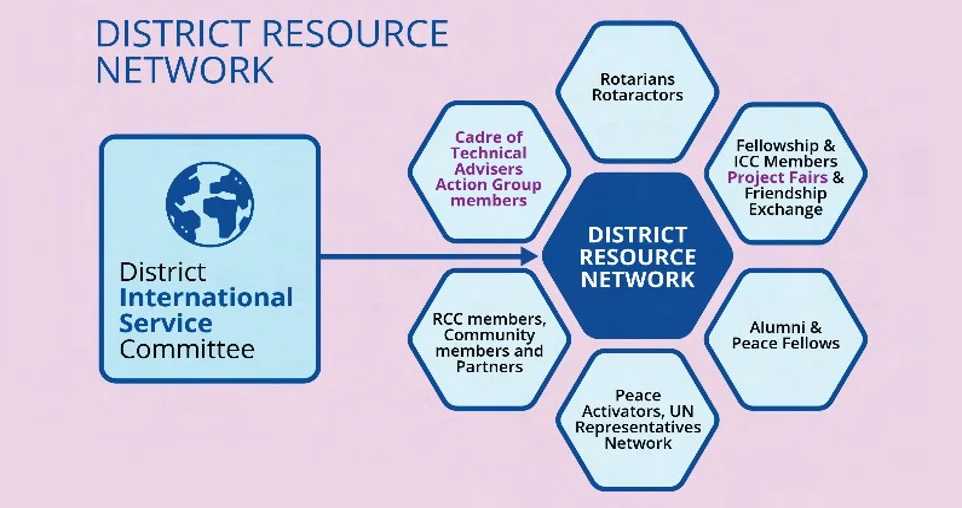
Too often, international service structures are perceived as one more layer competing for a district’s time. I want to be unambiguous: ICC does not compete with your district leadership,we exist to strengthen it. Alongside DISCs, District Rotary Foundation Chairs, and the Cadre of Technical Advisers (CADRES), ICC is one part of a single, connected District Resource Network built to answer one question every club eventually asks: who has already done this, and will they help us do it well?
When a club wants to launch a global grant project, they need more than good intentions. They need a partner country, a mentor who has written a winning grant application, and technical guidance in which ever of Rotary’s areas of focus they are tackling. That is precisely the intersection where ICC lives: identifying and formalizing partnerships between clubs and districts across the world, so expertise does not have to be reinvented in every corner of Rotary, every single year.
Collaboration Is Not a Value Statement. It Is Our Methodology.
This is why our relationship with CADRES matters so much to me this term. CADRES brings deep, credentialed technical expertise, the kind that strengthens a grant application or de-risks a complex project before it ever reaches implementation. ICC brings international relationships and cross-border agreements that let that expertise travel to where it is needed. Neither of us is complete without the other, and neither of us is complete without the DISC, who sits at the center of the district’s resource network, or without the District Governor, whose leadership makes this collaboration possible in the first place.
My call to every DG this biennium is simple: appoint your DISC and empower them to build relationships with your ICC chair and your CADRES contacts from day one. My call to every DISC is equally direct: you are the connector. Your job is not to hold expertise; it is to know exactly where it lives and to make the introduction. And my call to every club international service chair: do not wait until your project stalls to look for a mentor.
Introduce yourself to your DISC today and ask to be connected to ICC’s global network of partners.
Positioning Ourselves as the Resource of Choice Over the next two years, the ICC Executive Council is committing to making ourselves easier to find, easier to work with, and impossible to overlook. We are strengthening our data on active agreements, improving how districts discover potential partners and deepening our coordination with CADRES and DRFCs so no district ever must choose between resources. They simply gain access to all of them, through one connected network. This is what “resource of choice” means in practice: not a slogan on a slide, but a District Governor’s first instinct, when a club raises its hand for an international project, to say, “Let’s call ICC.”
“Reach out to your ICC. Let’s build this together.”
I am motivated by what I see in that photograph from our early years: Rotarians who decided that collaboration across difference was worth the effort. Seventy-six years later, with clubs on every continent seeking partners, mentors, and meaning, that effort is more valuable than ever.
Reach out to your ICC. Let us build peace together.

Annemarie Mostert
Rotary e-Club d'Eagle Canyon
District 9400 -Afrique du Sud


 English
  French
  Spanish
  Italian