
Italy and India: A Cultural Bridge Beyond Borders
By Cristina Rodondi -Delegate D2050 CIP Italy Malta San Marino -India
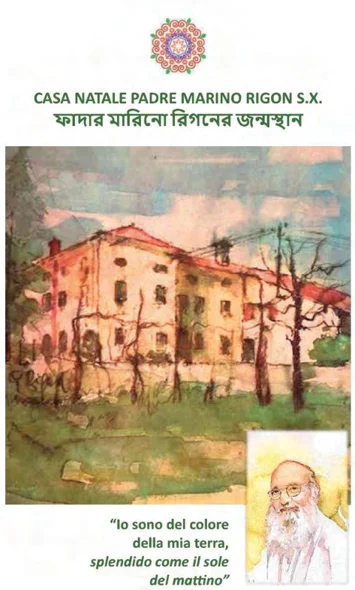
Connections between Italy and India often emerge in the most unexpected contexts and are far more numerous than we might imagine. A meaningful example was brought to my attention by my friend Prof. Urmila Chakraborty, an honorary member of my Rotary Club Brescia Next, who has long promoted knowledge of Indian culture and the thought of Rabindranath Tagore. She introduced me to the birthplace and small museum dedicated to Father Mario Rigon in Villaverla, near Vicenza.
I thus discovered one of the most fascinating stories of dialogue between our country and Bengal.
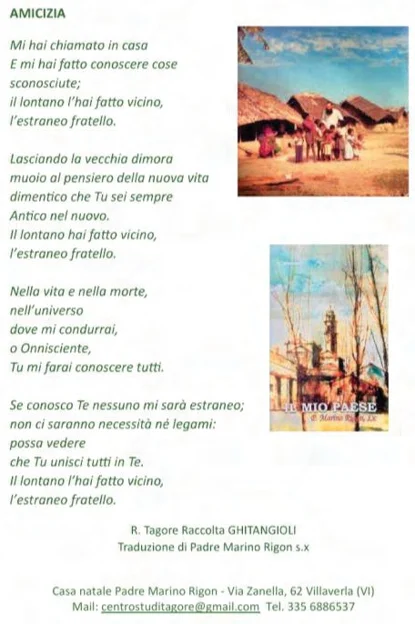
Father Mario Rigon was the first, and perhaps the only, translator to make Tagore’s works available in Italian by translating them directly from Bengali, without the mediation of English.
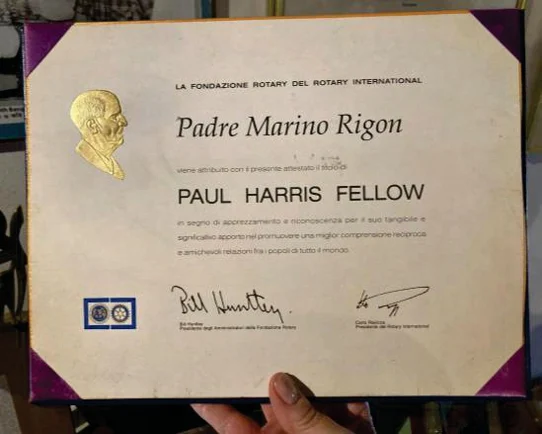
His long missionary experience and deep connection with Bengal enabled him to gain profound knowledge of a complex and extraordinary culture, making him a genuine bridge between East and West. His expertise and openness toward the Bengali world were also recognized by Rotary, which awarded him the prestigious Paul Harris Fellow recognition during the year in which the Italian Carlo Ravizza served as Rotary International President.

Urmila Chakraborty was already familiar with Father Rigon’s work and activities, having studied Tagore’s life and thought in depth. The intellectual meeting of these two cultural paths demonstrates how literature and dialogue among peoples can create genuine and lasting relationships between India and Italy.
Tagore, winner of the Nobel Prize in Literature in 1913 and born in Bengal, is one of the most authoritative figures in world culture. It is significant to remember that Father Rigon carried out much of his mission in present-day Bangladesh, which until 1947 was part of India and belonged to the great historical region of Bengal. Beyond the political divisions that emerged over time, Bengal continues to constitute a shared cultural and linguistic reality between India and Bangladesh.
But why does Tagore remain so important? His greatness lies not only in poetry, fiction, or philosophy, but in his vision of humanity as a single and indivisible reality. According to Tagore, there is no ‘us’ opposed to ‘them,’ nor one universe separate from another. Human beings transcend nationality, citizenship, and religious affiliation. Starting from the cultural and religious syncretism that characterizes the Indian tradition, Tagore arrived at a truly universal conception of the individual and of coexistence among peoples.
This vision shows a strong affinity with the founding principles of Rotary International, which promotes friendship among people from different cultures, mutual understanding, and the building of peace through service. Tagore’s idea of a common humanity, free from prejudice and division, directly recalls Rotary’s commitment to peace, dialogue, and international cooperation. It is therefore no surprise that Father Mario Rigon, interpreter and disseminator of Tagore’s thought, found natural recognition within Rotary.
The visit to Villaverla and the memory of Father Rigon preserved by his family, especially his niece Alessandra, and by all those who had contact with this great man, testify that the bond between Italy and India is not merely a relationship between countries. It is a story of people, cultures, and shared values rooted in the past and which we can continue to cultivate for the future.
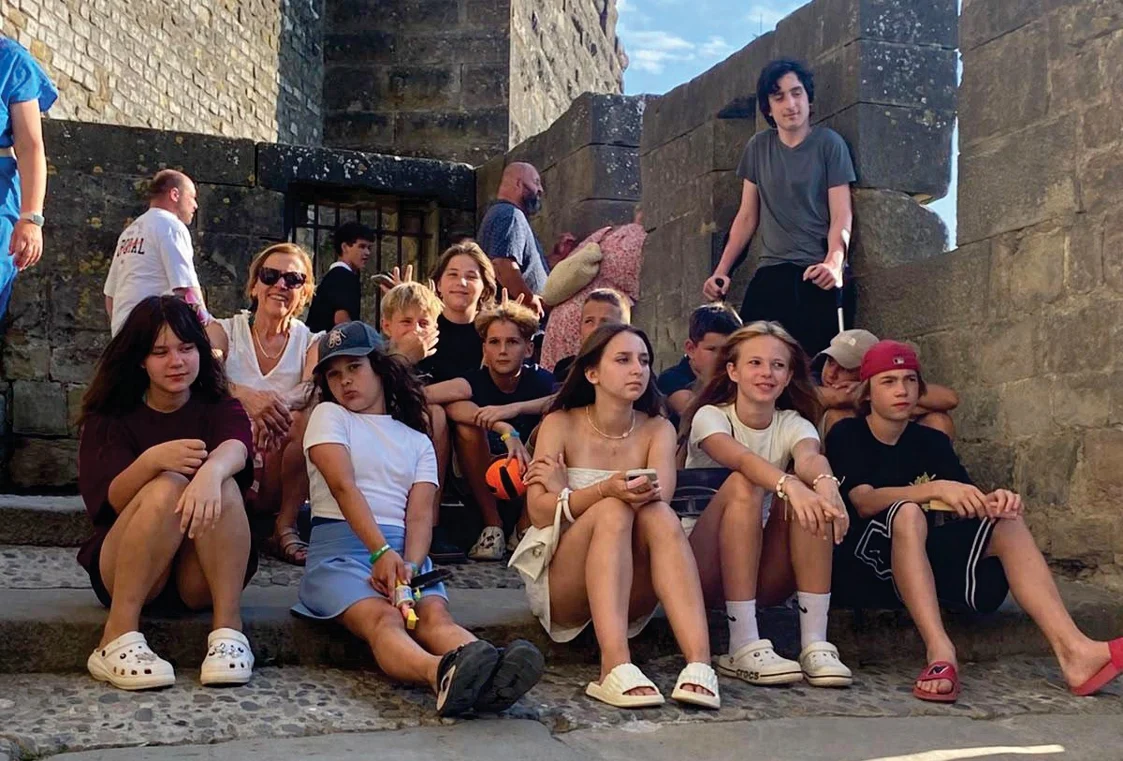
The Rotary club of Kiev Balzac with the help of dedicated Rotarians from ICCs USA, France, Ukraine were able to send a group of 15 Ukrainian orphans from the war in rehabilitation summer camp in South of France.
This project touched my heart deeply knowing the suffering of those kids who lost one or 2 parents in the awful war in their country. You can see them on the picture visiting Carcassonne, my hometown.
With emotion I imagine them learning about the traps of a medieval city under Charlemagne, my city’s history, and learning how sweet it is to be at peace with no bombs, no drones.
Peace is just beautiful! How lucky we are to live in peace in a free country. In spite ofdifficulties (fire, heat wave, interdictions) the French Rotarians made it happen for those traumatized children. I am so proud of those Rotarians!
This is my Rotary moment!

Rotary Izmir Dokuz Eylül
District 2440, Turkey - Past District Governor
Past Rotary Public Image Coordinator
Turkish Rotary Magazine board member
Active member of the WASH and SRoF fellowships
TRF CADRE


 English
  French
  Spanish
  Italian