
What Can I Do?
By Edward Wayne Jr. – Founder and Director of The Bridge of Life.
Before I tell you about what my wife, Tanya, and I have been doing in Ukraine, I should explain how we ended up here.
I grew up in Houston, Texas, and was fortunate in business. I built a company that eventually became multinational, and about thirty-five years ago, I sold it.
Suddenly I had time, energy, and some financial resources. And I began asking myself a simple question:
What can I do with them that might make a difference in somebody else’s life?
That question eventually took me to the Balkans during the wars surrounding Kosovo and Serbia. One telephone call led to another, and within about fortyeight hours I found myself helping establish a camp for displaced men, women and children in Macedonia.
I had no idea where that decision would lead. But one thing led to another.
After the war, I became involved in developing a pediatric oncology unit in Serbia. Later came humanitarian work following the tsunami in Thailand, the earthquakes in Nepal, and work involving children and adolescents in Myanmar.
Different countries. Different problems. But essentially the same question:
There is a problem in front of us. Is there something practical we can do about it?
Then came Ukraine.
In February 2022, Tanya and I were considering an entirely different humanitarian project when Russia launched its full-scale invasion.
We decided that whatever experience, energy and resources we had were probably more useful here.
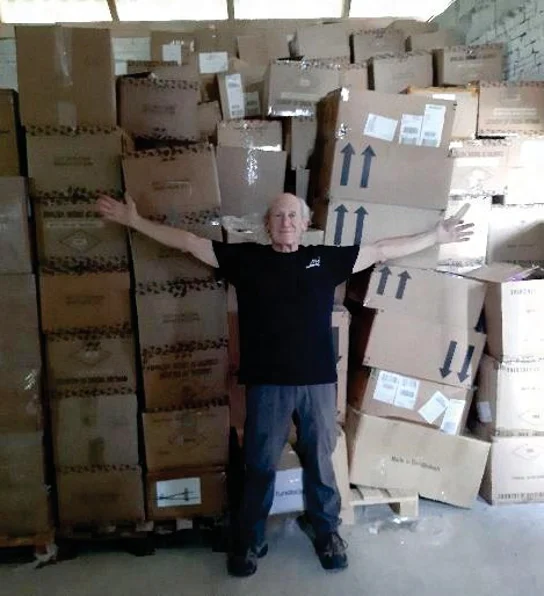
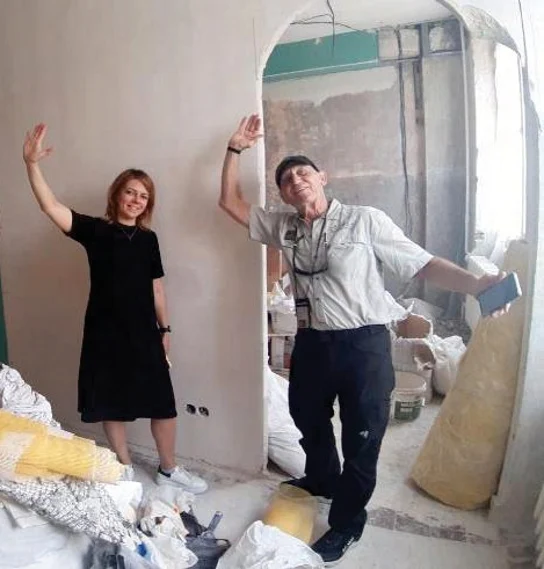
So we came to Ukraine.
Our plan was to stay for about three months. We’re now in our fifth year.
Apparently, Tanya and I are not very good at three-month plans. Ukraine became our home, and once again, one thing led to another.
One of our early projects involved children receiving psychiatric treatment in Lviv. Immediately outside their clinic was an unused enclosed courtyard.
We looked at it and asked:
Why couldn’t that space become part of their recovery?
So we transformed it into a secure outdoor park where children could experience fresh air, nature, physical activity and, perhaps most importantly, simply be children for a while.
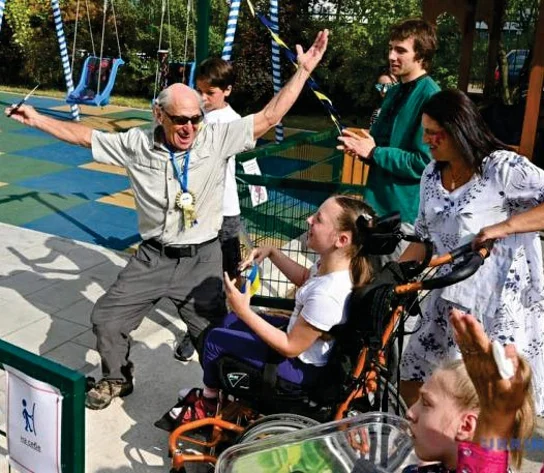
That led us to Dzherelo, which serves children with serious physical and developmental disabilities. We created an inclusive outdoor park designed around the children rather than expecting the children to adapt to the equipment.
We built swings that could safely carry children in wheelchairs and a merry-go-round capable of carrying several wheelchairs at once.
The engineering was complicated.
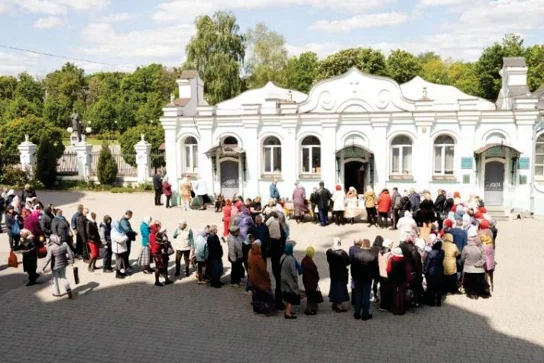
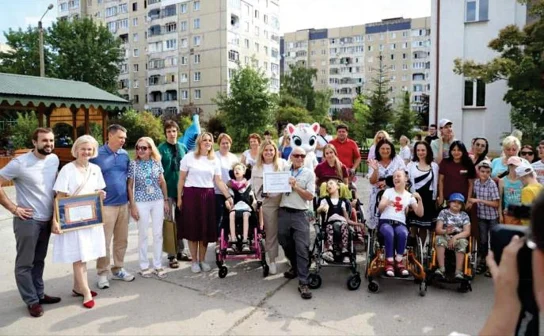
But once the children started laughing, the engineering didn’t matter anymore.
That taught me something I have seen repeatedly during thirty-five years of humanitarian work:
The importance of a project is not determined by its price tag. It is determined by whether somebody needs it.
And one thing led to another: Building hospital rooms and wards, more playgrounds, building modular schools for mentally and physically challenged children, food delivery to Kharkiv, Nike purple jackets and clothes delivery to the eastern villages, and so on…
And then came the dogs.
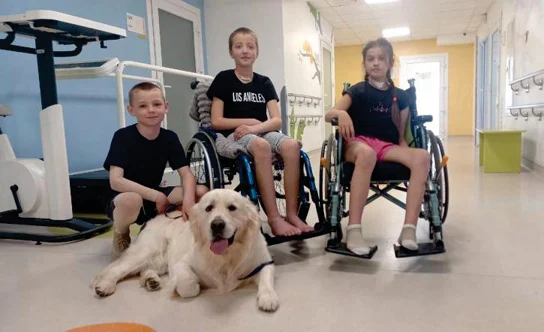
I had seen the impact of therapy-dog programs in the United States and wondered whether something similar could work in Ukraine.
We found extraordinary people in Lviv, established professional training and medical standards, worked through hospital requirements, and eventually received permission to introduce therapy-dog teams into Ukrainian hospitals and rehabilitation centers. That was the moment I understood these dogs were doing something far more important than making pleasant hospital visits.
We later began bringing them to wounded soldiers and other patients undergoing rehabilitation. I have watched a terribly wounded soldier slowly stroke Alto and then smile when the dog looked into his eyes.
One of those dogs is Alto.
There is one little boy I will never forget.
He had been at school with his mother when a Russian attack occurred. His mother threw herself over her son to protect him.
She was killed.
The little boy lost an arm.
By the time we saw him at the Super humans rehabilitation center, his physical treatment had been successful, but he had lost far more than an arm. He had lost his mother, his home and much of the world he understood.
He sat silently behind a glass door, rolling a ball back and forth.
Then he saw Alto. We opened the door.
Alto went directly to him.
The little boy wrapped his arm around the dog. Then he looked at his father and, for the first time since the attack, he spoke.
He said:
Daddy. Dog.
Two words.
No speech.
No complicated machine.
Just a wounded human being and a dog.
Perhaps dogs understand something human beings occasionally forget. They don’t care about nationality, religion, politics, rank, disability or injury.
They simply see another living being.
Our work has also included supporting trained medical volunteers working in dangerous areas, helping obtain ambulances and equipment, and moving humanitarian supplies where they are needed.
And then there was our 1997 Toyota 4 Runner. Does it look impressive?
We had owned that Toyota for twenty-eight years. Our children knew it. Tanya and I had traveled around the world with it. It was almost part of the family.
Eventually we realized it could be more useful as an extraction vehicle in eastern Ukraine, traveling on roads where ordinary ambulances sometimes could not go and helping medical teams bring wounded people out.
Giving it away was surprisingly emotional.
But our old family member wasn’t retiring. It had a new job.
There is a lesson in that old Toyota.
Humanitarian work doesn’t always look impressive.
Sometimes humanitarian work looks like a twenty-eight-year-old Toyota.
The important question isn’t: Does it look impressive?
The question is:
Will it do the job?
Over the years, Tanya and I have also learned that good intentions are not enough. Humanitarian work requires accountability and humility. Know where assistance goes.Know who receives it.
Listen to the people who actually understand the problem.
Know what you know —and know what you don’t know.
Sometimes your greatest contribution is simply connecting somebody who has a problem with somebody who knows how to solve it.
And that brings me back to Rotary.
Rotarians already understand service. It is built into the organization.
Not everyone needs to come to Ukraine.
Not everyone needs to build a children’s center, train a therapy dog or move an ambulance across a
border.
But everybody has something.
Time. Knowledge. Experience. Relationships.
An idea.
Resources.
Sometimes simply the willingness to make a telephone call.
When I sold my company thirty-five years ago, I asked myself:
What am I going to do now?
Eventually I realized there was a much better question: What can I do?
There is an enormous difference. What am I going to do?is about me.
What can I do? is about the person standing in front of me.
You don’t have to change the entire world.
Look around your own community. Look at your profession. Look at the people you know and the abilities you have accumulated over a lifetime.
Then ask yourself: What can I do?
Maybe the answer seems very small.
That’s all right.
I have spent much of the last thirty-five years watching how one small act led to another.
And I can tell you:It adds up.
Tanya and I came to Ukraine believing we would stay for three months.
We are still here.
And almost every morning begins with essentially the same question:
What can we do today?
We don’t always know the answer.
But we’re still asking the question.
And perhaps that is what keeps us going.

Rotary Izmir Dokuz Eylül
District 2440, Turkey - Past District Governor
Past Rotary Public Image Coordinator
Turkish Rotary Magazine board member
Active member of the WASH and SRoF fellowships
TRF CADRE


 English
  French
  Spanish
  Italian