
From Relationships to Action: ICC Leaders Meet in Palanga
Intercountry Committee Meeting | Palanga, Lithuania | 6 September 2026
By PDG Marius Grigelionis – D1462 – ICC National Chair (Lithuania)
The traditional Intercountry Committee meeting held in Palanga, Lithuania, on 6 September brought together ICC leaders, District Governors and Rotarians from across Europe and beyond to discuss a question central to the future of the ICC movement: how can established relationships between countries be translated into practical resources for districts, peacebuilding and lasting international service?
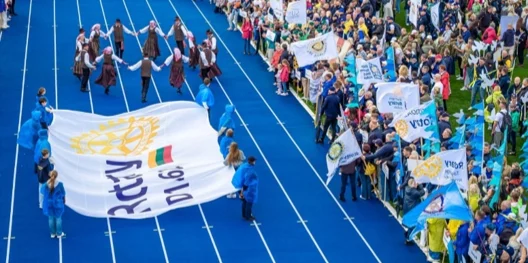
The meeting formed part of an exceptional Rotary weekend in Palanga. The 25th anniversary Rotariada, Lithuania’s largest annual Rotary gathering, brought together more than 1,500 Lithuanian Rotarians and family members and almost 400 international guests from 20 countries. Alongside the traditional programme of fellowship and sport, Palanga hosted a Rotary Action Summit, training for incoming District Governors and a visit by Rotary International President Yinka Babalola.
For the ICC community, this setting was particularly significant. What began in Lithuania in 2002 as a gathering of several Rotary clubs has developed into an event involving around 80 clubs and, this year, more than 2,000 participants. Bringing an ICC meeting into this environment connected international cooperation directly with the wider Rotary community rather than treating it as a separate ICC activity.
A meeting focused on the next chapter of ICC
District Governor Andrius Barniškis opened the meeting, followed by a video address from Annemarie Mostert, President of the ICC Executive Council. Andrzej Ludek, Past President of the ICC Executive Council and Senior Advisory – Continuity, then presented the 2026-2028 ICC perspective.
The international dimension continued with Robin Charlesworth of the Rotary E-Club of of Houston Vice-President of the ICC National Committee and a leader of ICC USA-Ukraine, presenting ICC activities in the United States. ICC National Chair for Lithuania PDG Marius Grigelionis presented ICC activities in Lithuania.
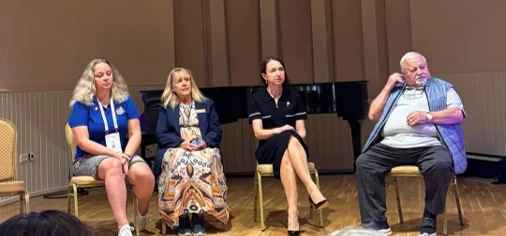
The presentations also illustrated the breadth of experience gathered in Palanga. The meeting brought together ICC Executive Council leadership, District 1462 leadership, and ICC practitioners from Denmark, Germany, Lithuania, Poland, the United States, Ukraine and other countries . But the programme was deliberately designed to go beyond presentations.
Two 30-minute panels addressed issues that increasingly determine whether ICCs remain networks of friendship or become strategic resources capable of producing measurable Rotary action.
Peace through relationships – and through action
The first panel, “International Peace Initiatives,” brought together Robin Charlesworth; PDG Jurgita Turulienė of Lithuania; Erich Prezewowsky, Chairman of the Germany-Lithuania Intercountry Committee; and Iryna Timanyuk, Co-Chair of the ICC Ukraine-USA Committee.
For ICCs, peace is not an abstract addition to their mission. Relationships between Rotarians in different countries can preserve dialogue, create trust and provide networks through which humanitarian and community initiatives can be implemented when circumstances become difficult.
That discussion had particular resonance in Palanga. During the same Rotary weekend, Lithuania hosted the Ukrainian Heroes Games for the first time. Twenty-five Ukrainian soldiers and veterans who had suffered severe war injuries and amputations participated. District 1462 has directed more than EUR 2 million in humanitarian and social assistance to Ukraine since the beginning of the full-scale war, while maintaining Rotary’s distinction between humanitarian support and military assistance.
The presence in the ICC panel of representatives directly engaged in USA-Ukraine cooperation therefore gave the subject an immediate practical context. For an ICC audience, the underlying question is increasingly important: what happens after an international relationship has been established?
Friendship and dialogue remain fundamental, but their potential becomes much greater when relationships enable humanitarian action, community resilience, youth engagement, professional cooperation and longer-term recovery. In that sense, peacebuilding through ICC is not necessarily a single “peace project.” It can be the accumulated result of trusted relationships that allow Rotarians in different countries to act together when action is needed.
Can ICC become a resource that every district actually uses?
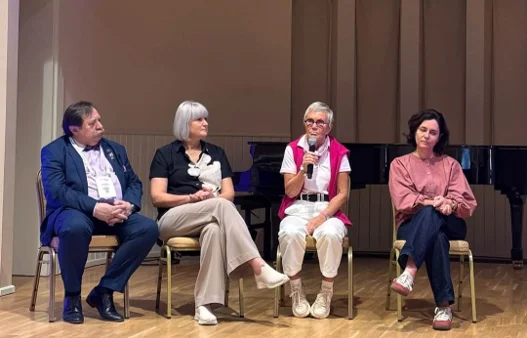
The second panel moved from mission to organisational practice. Under the title “ICC as Every District’s Resource of Choice,” Andrzej Ludek was joined by Eglė Kesylienė, Chairman of the Lithuania-Norway Intercountry Committee; Anette Løwert of Denmark, whose Rotary service includes senior Foundation, PolioPlus, training and district leadership responsibilities; and Edita Katinaitė-Kalčiūnienė, Chairman of the Lithuania-Denmark Intercountry Committee.
The composition of the panel reflected an important point: the future relevance of ICC does not depend only on ICC leadership. It depends on how effectively ICC connects with District Governors, The Rotary Foundation, clubs and Rotary’s other professional and service resources.
For experienced Rotarians, the challenge is familiar. A club may have an excellent international project idea but lack a trusted partner in another country. A district may need local knowledge before entering a new partnership. A Global Grant initiative may require both international contacts and experienced Rotary expertise. Peacebuilding or environmental projects may need several districts rather than one bilateral relationship.
The ICC network potentially addresses precisely this gap: it already contains relationships, country knowledge and trusted Rotarians across borders. The strategic question is therefore less about creating additional Rotary structures and more about making existing international relationships accessible and useful to the districts and clubs that need them.
For District Governors in particular, this also raises the question of continuity. Governors serve defined terms; international relationships frequently develop over many years. ICCs can help preserve those relationships across successive Rotary leadership cycles while giving new district team an established network from which to work.
A new USA-Lithuania connection
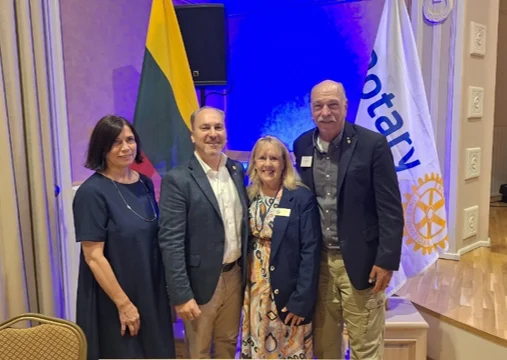
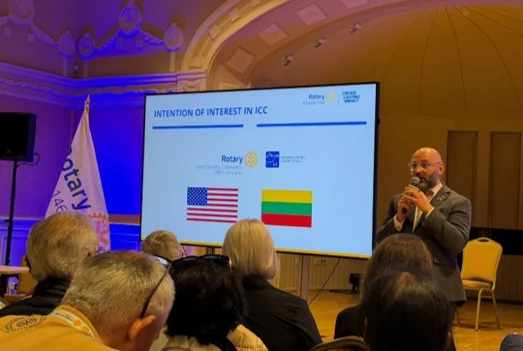
Palanga also produced a tangible next step. The programme included the kick-off of a new USA-Lithuania Intercountry Committee, adding a new bilateral relationship to Lithuania’s expanding ICC network. The meeting presentation gave this initiative its own place in the programme, visually bringing together the flags of Lithuania and the United States under the Intercountry Committee identity.
Its significance lies not simply in adding another committee. The measure of the new relationship will be what follows: club connections, projects, exchanges, peacebuilding initiatives and opportunities that neither side would have developed as easily on its own. That is also a useful measure for the wider ICC movement.
ICC within a larger Rotary ecosystem
The Palanga meeting did not take place in isolation. Rotariada itself combined fellowship, service, international participation and public engagement. The weekend included the Rotary End Polio charity run, support for Lithuania’s Paralympic movement, the Heroes Games and the Rotary Action Summit.
That broader setting offered an appropriate backdrop for the ICC discussions. Intercountry Committees are at their strongest when international friendship is not an end point but an infrastructure for action: connecting people who would otherwise not meet, helping districts find trusted counterparts, carrying relationships across Rotary years and turning international understanding into service.
The Palanga programme brought those dimensions together: continuity, peace, district leadership and practical international cooperation.

Rotary Paris Agora - Past President 22-23
District 1660, France - Head of IT, Past DPIC
Region 14 - ARPIC
Cercle Polioplus - Co-Founder


 English
  French
  Spanish
  Italian