
When the Earth shook, Rotary moved
By James Onions – ICC Executive Council –Learning & Development Working Group Lead
From the devastation of Türkiye’s 2023 earthquakes came an extraordinary Rotary initiative. A conversation between friends became an international partnership, a Global Grant and, ultimately, life-changing treatment for severely burned children.
WHEN THE EARTH STOPPED SHAKING, THE SUFFERING DID NOT
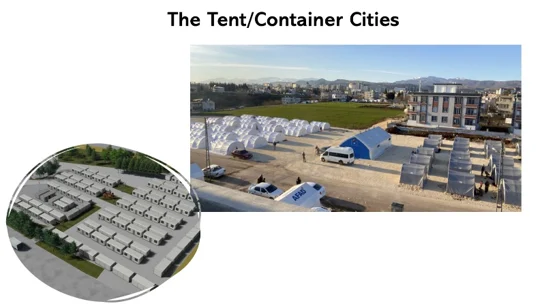
The earthquakes that struck Türkiye in 2023 left devastation on an enormous scale. Homes disappeared, families were displaced, and communities were forced into emergency accommodation.
For some children, there was another terrible consequence.
They suffered severe burns, either directly during the earthquake or later through accidents in the cramped and difficult conditions in which displaced families were living.
The immediate earthquake had passed. But for these children and their families, the emergency was continuing.
Rotarians in Türkiye and Great Britain & Ireland saw the need and began asking a very practical question: What can we do?
That question would eventually bring together Rotarians across several countries and lead to a Global Grant of more than $50,000.
But it began with a conversation.
A CONVERSATION BECOMES A DECISION
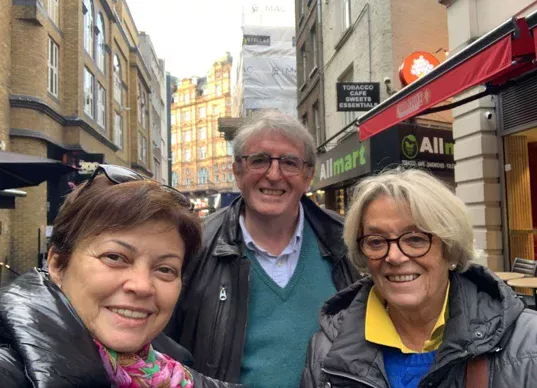
At an in-person Intercountry Committee networking meeting, Grace Gibbs and James Onions from GB&I and Canan Ersoz from Türkiye discussed how Rotary might respond.
They learned about an innovative treatment for children suffering from severe burns.
The procedure uses skin cells taken from the patient’s own body. These are mixed with a selected enzyme to produce a solution that can be sprayed onto a mesh-type wound dressing.
The potential was striking. The solution could be prepared in about 30 minutes. It required only around 6 per cent of the patient’s skin that would normally be needed for a conventional autograft. Treatment time could be reduced, recovery improved and residual scarring substantially decreased.
Here was a possible solution.
But there was a problem.
The doctors needed the equipment and materials to deliver it.
For the Rotarians involved, this was the moment when sympathy had to become action.
They decided to create a Rotary Global Grant.
FROM FRIENDSHIP TO ACTION
That decision changed everything.
What had started as a discussion between a few Rotarians became a multi-country, multi-district and multi-club effort.
Türkiye, Great Britain & Ireland, Austria and Germany became involved. Turkish Districts 2420, 2430 and 2440, Austrian District 1920 and GB&I Districts 1145 and 1120 contributed District Designated Funds.
Together they provided $17,000 in DDF. Rotary clubs raised a further $19,620, with the largest club contribution coming from the Rotary Club of Hamelin in Germany. The Rotary Foundation added another $13,600.
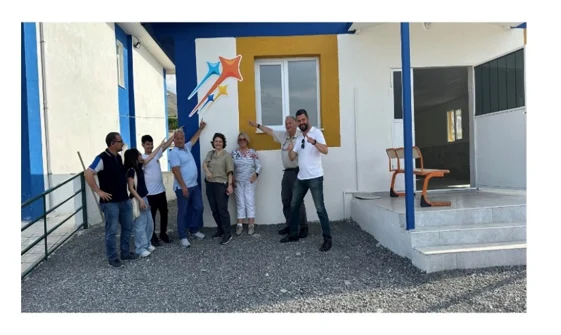
The result was a Global Grant worth more than $50,000.
District 1145 became the international sponsor. The Rotary Clubs of Twickenham upon Thames, Kew Gardens and Kingston joined the team working with the host Rotary Club of Samsun, supported by the Rotary Club of Malatya.
This was Rotary’s international network doing exactly what it can do best: bringing together people who would otherwise be separated by geography, institutions and borders and focusing their combined resources on a specific human need.
THE GLOBAL GRANT REACHES THE HOSPITAL
Once The Rotary Foundation approved the grant, the partnership moved rapidly from fundraising to treatment.
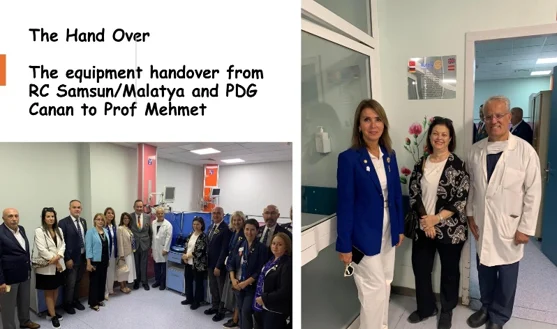
Rotarians worked with Professor Mehmet Demircan at the Paediatric Burns Centre of the Department of Paediatric Surgery at Inönü University School of Medicine in Malatya.
The project provided equipment and enzymes sufficient for up to 100 applications of the procedure.
An essential piece of equipment was a specially designed laboratory shaker. It allows skin cells taken from the child’s own body to be mixed with the selected enzyme and prepared as a solution suitable for spraying onto the wound dressing.
The project did more than provide technology.
Parents were taught about the treatment and the follow-up care their children would need. They also received guidance about preventing similar accidents in the future.
The objective was not simply to respond to an emergency.
It was to leave behind knowledge and capability.
85 CHILDREN. 100 TREATMENTS. 100% SURVIVAL.
The numbers tell an extraordinary story.
Following clinical training, the medical team treated 85 children, aged from only seven months to 17 years.
They received 100 treatments.
These were not minor injuries. The children had burns affecting 75 per cent or more of their bodies.
Most resulted from scalding, while others were caused by high-voltage electricity, direct flames or explosions.
The reported survival rate was 100 per cent.
Residual scarring was also significantly lower than would have been expected without the epidermal spray treatment.
But statistics tell only part of the story.
Behind every number was a child.
Behind every child was a frightened family.
And behind the treatment was a chain of people, clubs and districts in different countries who had decided that distance was no reason to stand aside.
“THE MAGICAL POWER OF ROTARY”
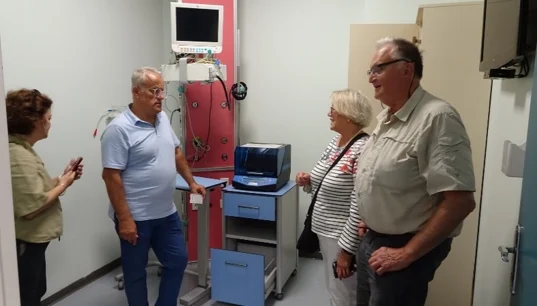
Grace Gibbs, now Assistant Governor in District 1145, later visited the Burns Centre with Francis Hodge, Assistant Governor in District 1120, to monitor the project and see the results.
Professor Demircan summed up what the partnership had achieved: “The magical power of Rotary has combined with the needs of paediatric burn patients… With this wonderful treatment method, our patients are recovering faster and are quickly reintegrating into society.”
Grace Gibbs saw another dimension to the achievement: That matters because this relatively low-cost approach could potentially be relevant to other disaster areas and regions where medical resources are limited.
THE REAL POWER OF AN ICC
There is an important lesson here.
An Intercountry Committee cannot stop an earthquake.
It cannot rebuild an entire city or remove the suffering caused by a natural disaster.
But it can do something immensely valuable before disaster ever strikes.
It can build relationships
And when an emergency comes, those relationships can become pathways to action.
The people know one another. They can connect clubs and districts. They can find expertise. They can identify resources. They can bring countries together. And, through The Rotary Foundation, they can turn an idea into a properly funded and sustainable project.
That is exactly what happened here.
The earthquake created the need.
Doctors identified a possible solution.
ICC relationships brought people together.
Rotarians mobilised clubs and districts across borders.
The Global Grant provided the means.
And children received the treatment.
PERHAPS THE MOST IMPORTANT RESULT IS STILL TO COME
The story does not necessarily end with these 85 children.
Professor Demircan intends to present the experience and results at national and international congresses and publish them in a recognised medical journal, acknowledging the support of The Rotary Foundation, districts and clubs.
That matters because this relatively low-cost approach could potentially be relevant to other disaster areas and regions where medical resources are limited.
A response born from the tragedy of one earthquake may therefore generate knowledge capable of helping children elsewhere in the world.
And that leaves us with a larger thought.
WE CANNOT ALWAYS PREVENT DISASTER. WE CAN DECIDE WHAT HAPPENS NEXT.
The real measure of an international network is not the number of countries it reaches, the meetings it holds or the friendships it creates.
It is what happens when somebody, somewhere, needs help.
The Türkiye burns project demonstrates what becomes possible when friendship is already in place, expertise is identified and people have the determination to act.
A devastating earthquake created pain and urgent need.
A conversation created an idea.
An international network created a partnership.
A Global Grant created the means to act.
And action gave children a better chance of life.
That is the journey from friendship to action – and from action to lasting impact.
The authors would welcome enquiries:
James Onions, PDG D1145, ICC Executive Council – Lead Learning and Development Workgroup
Grace Gibbs, AG D1145, ICC Chair GB&I – Turkey
Canan Ersoz, PDG D2430, ICC Executive Council, ICC Turkey-GB&I – Learning and Development Workgroup
Evelina Knowlton, ICC Executive Council – Learning and Development Workgroup

Rotary Paris Agora - Past President 22-23
District 1660, France - Head of IT, Past DPIC
Region 14 - ARPIC
Cercle Polioplus - Co-Founder


 English
  French
  Spanish
  Italian