
Rotary Beyond Volunteering: The Professional Capital That Can Unite Countries
There is an international resource of extraordinary value that we often use only partially: the professional expertise of people.
This consideration is particularly relevant to Rotary and its Intercountry Committees (ICCs), created to build relationships among Rotarians from different countries and to transform dialogue into cooperation, international understanding and concrete projects.
The starting point should be simple: a Rotarian brings much more than goodwill.
A Rotarian brings experience.
Entrepreneurs, physicians, engineers, lawyers, economists, managers, diplomats, academics and other professionals possess expertise built over decades of work. When these capabilities are connected through an international network based on trust, their value can multiply.
This is where ICCs can make a significant leap forward.
We should not regard them simply as a network of volunteers, but as an extraordinary human infrastructure capable of bringing diverse professional expertise together in pursuit of common objectives.
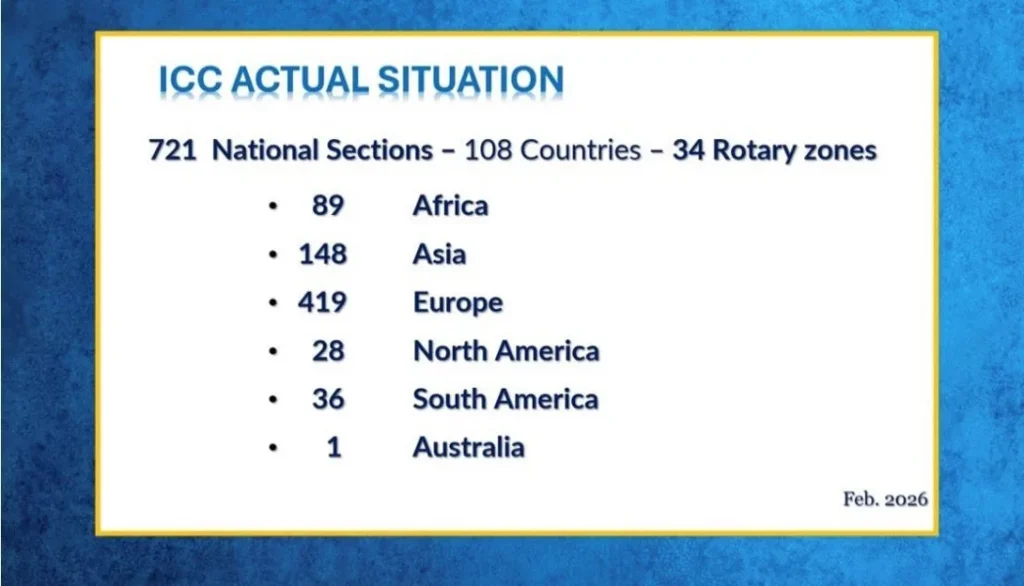
According to ICC strategic documents, the network comprises more than one thousand national and subnational sections across over 130 countries. It represents a legacy built through decades of international relationships—one that would be extremely difficult to recreate from scratch today.
The challenge is to transform this capital of trust into measurable results. work together.
This means applying to Rotary service some of the same principles we use every day in our professional lives: clearly defined responsibilities, realistic objectives, implementation timelines, leadership continuity and measurable outcomes.
An international project cannot depend solely on the enthusiasm of one individual. It requires a team, complementary expertise and, above all, the ability to continue when presidents and officeholders change.
Project financing should also be approached with a modern mindset. A strong humanitarian initiative is not simply a request for funding.
It is a structured project with reliable partners, a transparent budget, measurable results and the ability to attract resources from multiple stakeholders.
Within this model, Rotary can perform a role that is difficult to replicate: bringing together people who might otherwise never have met.
Rotaract is equally important. Involving younger generations in ICC leadership means combining experience with innovation, established relationships with digital capabilities, and institutional memory with new ideas.
Above all, however, we need to change a mindset.
The time a professional dedicates to Rotary is certainly voluntary. Their expertise, however, is professional.
The distinction may appear subtle, but it fundamentally changes the perspective.
We should not simply ask an engineer to “help”; we should enable that engineer to design. A physician should develop health programmes.
An entrepreneur should organise resources. A lawyer should build reliable frameworks. A young Rotaractor should introduce new tools, technologies and perspectives.
This is precisely where the strength of the Intercountry Committees lies: transforming personal relationships into lasting bridges between countries. Rotary already possesses people, expertise, international credibility and a global network.
The next challenge is not necessarily to become larger.
It is to make better use of what we already are.
Because service begins with willingness, but lasting impact is created when willingness, professionalism and responsibility.

Pierangelo Panozzo
Rotary Club Rome International
District 2080 - Italy

Annemarie Mostert
Rotary e-Club of Eagle Canyon
District 9400 - South Africa

Rotary Paris Agora - Past President 22-23
District 1660, France - Head of IT, Past DPIC
Region 14 - ARPIC
Cercle Polioplus - Co-Founder

 English
  French
  Spanish
  Italian